Is ‘discipleship’ Anglican?
 A few weeks agone, Linda Woodhead suggested in the Church Times that discipleship was a 'theologically peripheral concept', and the following calendar week Angela Tilby dismissed the 'd-word' as 'sectarian vocabulary that…shows the influence of American-derived Evangelicalism on the Church building's current leadership.' The short discussions in each place actually raise not one but three, inter-related, questions:
one. Is 'discipleship' Anglican?
2. Is 'discipleship' biblical?
three. Is the Church of England biblical?
On the first question, Tilby is certainly correct to notation that the 'd-discussion' is being used quite a lot at the moment. In his excellent Lambeth Lecture on evangelism, Justin Welby put the making of disciples key to the purpose of the church:
I desire to start past saying only two uncomplicated sentences about the church. Offset, the church exists to worship God in Jesus Christ. Second, the Church building exists to make new disciples of Jesus Christ. Everything else is decoration. Some of information technology may be very necessary, useful, or wonderful decoration – but it's ornament.
Autonomously from the study on discipleship discussed by Synod, the fascinating report on leadership from the Faith and Lodge Commission also drew on the term extensively. The term is mentioned 20 times, and in fact its rounded reflection on the nature of leadership roots information technology in the concept of discipleship:
Do the virtues being demanded of senior leaders today sit uneasily with the virtues of discipleship? A Christian leader is, afterwards all, a disciple outset and a leader second, and that means that he or she is and remains a follower even while being a leader. Furthermore, as a disciple a leader is called to display the fruit of the Spirit… (para 46, p xviii)
The 2 authors, Mike Higton and Loveday Alexander, are hardly people who have succumbed to 'American Evangelicalism', and in fact Higton has elsewhere suggested in a Grove Ethics booklet) that this NT idea of discipleship offers a paradigm for all educational learning:
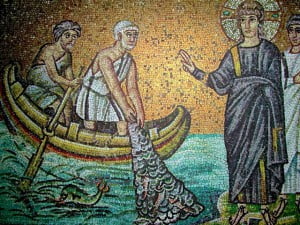
[In Marking one.18] Jesus sees what these ii men currently are, and calls them to a transformation—to a strangefulfilmentof what they are. Theyarefishermen (halieis), merely he calls them togo fishermen (halieis anthropon: fishers of people, 'fishers of men' in an older translations). Simon and Andrew answer past leaving what theyare, and beginning their journey towards this mysterious fulfilment—towards what theywill be. They become, in that moment, disciples. They become learners…They are captivated past the possibility of transformation. (p iv)
If 'discipleship' is not thought of every bit particularly Anglican, then information technology certainly needs to be. In an online discussion on this effect, David Runcorn asks this question:
What if our response (and Angela Tilby'southward) was to say at this indicate – we understand the word 'discipleship' but for a variety of thoughtful and theological reasons we don't use it. We prefer the word ……. for these reasons ……. Tin anyone fill up in the blanks here?
What word do we merits to exist authentically Anglican that sums up our calling to be a church building being led and leading others into radical conversion of life, taking up your cross, faith, prayer and holiness, self denial and the service of others, following Jesus, loving enemies, peacemaking, justice, attentiveness to scripture, obedience to the divine will and being formed in the likeness of Christ?
In terms of ordained ministry, what does the ordinal say nigh the part of priests/presbyters?
They are to be messengers, watchmen and stewards of the Lord; they are to teach and to admonish, to feed and provide for his family unit, to search for his children in the wilderness of this earth'southward temptations, and to guide them through its confusions, that they may be saved through Christ for ever. Formed by the word, they are to call their hearers to repentance and to declare in Christ's name the absolution and forgiveness of their sins.
With all God's people, they are to tell the story of God's love. They are to baptize new disciples in the proper name of the Father, and of the Son, and of the Holy Spirit, and to walk with them in the way of Christ, nurturing them in the faith. They are to unfold the Scriptures, to preach the discussion in season and out of season, and to declare the mighty acts of God.
What is interesting here is that, though the metaphor of 'discipleship' is non explicitly dominant, it is certainly present, and many of the terms present can easily be associated with ideas nowadays in the notion of discipleship. Information technology is no surprise and then that, not merely do a good number of dioceses now employ the linguistic communication of discipleship in their statement of diocesan mission or goals, so does the Pilgrim Course. It is 'a specifically Anglican resource' and 'a major new educational activity and discipleship resource from the Church building of England.' According to the Archbishop:
The Pilgrim Course has been used wonderfully by God both to bring people to organized religion in Jesus Christ and to enable them to grow as his disciples. It is my prayer that the consummate form will continue to exist an effective tool for the Church equally information technology seeks to fulfil, in God's grace, the urgent task of making disciples – so that the light of Christ may shine in every corner of this country through all who follow him.
So if you don't think discipleship is a very Anglican term, you are going to have to dissociate yourself from a good deal of what is happening in the Church today!
 It is still important to reflect on the identify that the idea has in Scripture. I would agree with Angela Tilby that 'There's little well-nigh disciples in the rest of the New Testament; certainly not in Paul's letters, in spite of his missionary passion.' But we demand to remember about this carefully.
First, the language of discipleship is not found per se, since the NT does non share our fondness for abstract nouns but prefers personal, concrete terms. So the question is to what extent 'disciples' (rather than 'discipleship') features.
Secondly, we need to note what existence a disciple involves. In the gospels, it includes iii cardinal ideas.
- The first is that of modify, a departure from i's current situation (literally or metaphorically), a new design of life. Typically this involves a moment of decision, and is summed up in Jesus' early preaching 'The fourth dimension has come up; the kingdom of God is at hand. Repent and believe the good news' (Mark 1.15).
- The second is the idea of journey, a commitment to learning from the ane the disciple is following. This is made explicit in Matthew's gospel, by gathering Jesus' teaching into five blocks (perchance imitating the five books of Moses). This then gives a ii-fold movement to the life of the disciple—an inward movement to assemble effectually the teacher and listen to his teaching, and an outward moving in mission and ministry to make this teaching and practice known. This is possibly what makes Matthew (in the words of ane commentator) 'a manual for discipleship'. This journey of learning is expressed in a slightly different way past Luke, who styles the key section of his gospel every bit a journey following Jesus 'on the manner' (from Luke ix.51 onwards).
- The third idea is that of community. Following the Jewish blueprint of being attached to a rabbi, it is clear that to exist a disciple, leaving behind the old way of life and embarking on a journeying of learning, means to join with a community of others on a similar journey. Such was the radical nature of this commitment that the band of disciples that you had joined actually displaced your natural family in terms of loyalty and solidarity. This is backside Jesus' shocking injunction to 'let the dead bury their own dead' (Matt 8.22) likewise as Jesus explicit education on who constituted his ain family (Matt 12.46–fifty). Matthew has this proverb stand on its own, just Mark characteristically wraps it around another episode—the debate about whether a house divided against itself can stand—in order to emphasise the sense of committed unity amongst the disciples (Marking 3.20–35).
These are all pretty central to whatever understanding of the Christian religion. As Tilby says, the thought of discipleship is only 'supported' in 'one part of the New Testament'; but when that 'ane function' is the gospels, and the back up comes from Jesus using it every bit a controlling paradigm, we had improve have information technology seriously. The term 'disciple' is used most frequently of The Twelve, merely it is not used and then exclusively. Moreover, The Twelve are frequently offered every bit models of what it means to be a disciple, warts and all; nosotros are not to read the gospel accounts as a history of the early leadership of the church building, just as a design of life and experience for all who want to follow Jesus. (Despite Tilby's protestations, Acts is similarly offered as a model for subsequent readers.)
Recognising these iii dimensions of discipleship makes sense of two things. First, you can begin to encounter how the ordinal, and other discussion in Anglican documents, touches on issues of decision, learning and community. They might not always use the term 'discipleship' explicitly, just this is the root from which such ideas bound upwards.
Secondly, this likewise makes sense of other terms that the NT uses. I would propose that the five terms 'disciple', 'family', 'kingdom', 'torso' andekklesia (citizens' gathering) are dissimilar ways of expressing this three-fold thought of decision, learning and community, but with slightly different emphases and deployed in different contexts. For instance, Paul's language of Christians as 'the torso of Christ' clearly includes the sense of demarcation that comes from decision (1 Cor 12.3) and the idea of common belonging is powerfully expressed. Simply because learning is non an obvious part of this (slightly static) metaphor, Paul adds to it the notion of 'building upwards' (i Cor fourteen.four, 12). Information technology would be perfectly possible to map each of these 5 ideas onto each other, and meet where and how the three elements are expressed.
But why should anyone resist discipleship as an important office of the Church of England's self-understanding? In a recent word on the Facebook page of Irresolute Attitude, someone complained nearly how the C of East is becoming 'more evangelical' and is unclear why this is. If true, I think there is one fairly simple reply: evangelicals have taken the thought of making disciples more seriously than other traditions in the Church. Equally Justin Welby comments, the idea of making disciples is not a reaction to falling attendances or a only a means to refill the pews. Rather,
Witness and evangelism are expressions of the overflow of the love and joy of the grace of God into our lives, and the life of His whole Church and His whole world.
But empty pews won't be filled without information technology. So if discipleship is biblical, and making disciples isn't very Anglican, it is perchance simply at this moment that the Church of England needs to become a little more biblical again.
Much of my work is washed on a freelance footing. If you have valued this post, would you considerdonating £i.20 a month to support the production of this blog?
If you enjoyed this, do share it on social media (Facebook or Twitter) using the buttons on the left. Follow me on Twitter @psephizo. Like my folio on Facebook.
Much of my work is washed on a freelance basis. If you accept valued this post, you lot can make a single or repeat donation through PayPal:
Comments policy: Good comments that appoint with the content of the post, and share in respectful debate, tin add real value. Seek commencement to empathize, then to be understood. Make the most charitable construal of the views of others and seek to learn from their perspectives. Don't view debate as a conflict to win; accost the statement rather than tackling the person.
winderseentiourcio.blogspot.com
Source: https://www.psephizo.com/life-ministry/is-discipleship-anglican/
0 Response to "Is ‘discipleship’ Anglican?"
Post a Comment