What is God doing in the beheading of John the Baptist?
 Yesterday's lectionary gospel reading, Mark 6.14–29, felt distinctly odd by any mensurate. If y'all are a good Anglican, and ensure you read not merely from the NT and the Psalms just also from the Old Attestation every week, it will take been less of a surprise. Past contrast, if you are into popular civilisation and have go a fan of the TV series Game of Thrones, or perhaps play the latest generation of video games, so information technology volition not have seemed so strange. But what is the passage doing here, as part of the 'good news' that Mark offers usa of Jesus, and why does he requite so much time to information technology in his shortest of gospels—much more time than he gives to his description of the resurrection, the efforts of later editors of the end of the gospel notwithstanding?
You might well have heard a well-structured, engaging exposition of the human actors hither, as I did yesterday in the church we were visiting. It is non so much Game of Thrones as a game of consequences, which each stage of the drama unfolding tragically but with some inevitability into the next. What happens if y'all are built-in into a family whose patriarch is a ruthless merely insecure tyrant (Herod the Great) who forged a regime from nothing and was a monumental builder, simply achieved this by having his own wife and two sons executed? What happens when you lot live with bitter rivalry, having inherited both your begetter's aggressive and his insecurity, which leads you into state of war and ultimate defeat? What happens when your sexual interests lead y'all to fall in beloved with your own relation (Herodias was Herod the Great'south grand-daughter past Mariamne)? What happens when y'all are at the same time disturbed and fascinated by a prophetic vocalisation of criticism and cannot resolve this conflict in yourself? What happens when you blurt out impulsive promises which make you vulnerable to the scheming of others close to you? None of this ended well for Herod Antipas, who finally lost his power and his throne—but information technology concluded worse for those effectually, including John the Baptist, who lost his head.
Nosotros are left with a poignant moral tale, full of dynamic and pathos, told in a such a way as to inspire many a Hollywood moving picture script. The moment of hubris comes as Herod declares, repeatedly and with growing emphasis, his delight in his girl:
The king said to the daughter, "Enquire me for anything you lot want, and I'll requite it to you." And he promised her with an oath, "Whatsoever y'all inquire I volition give you lot, up to half my kingdom." (Mark half dozen.22–23)
And this is almost immediately followed by his nemesis, his downfall, fabricated the more stinging by his daughter request non just for the head of John the Baptist, as her mother had directed her, merely asking for it 'correct now' and 'on a platter'. The dishes on which Herod had served his guests the choicest foods as a demonstration of his lavish generosity and wealth would now serve up to him his folly and his pride in front of those very same guests—in the virtually gruesome fashion possible.
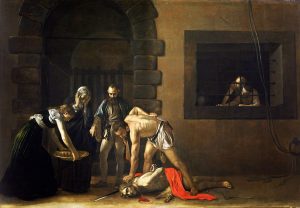
No wonder, then, that Caravaggio, the impulsive and conflicted genius of Renaissance art, chose to indulge his obsession with gruesome beheadings by painting this scene (now hanging in the St John's Co-Cathedral in Valletta, Malta). His flick is startling in all sorts of means, and not but because of his characteristic apply of tenebrism by which the light and night elements of the painting are in such striking dissimilarity, with the human figures often illuminated from the side so that their features stand out in sharp relief. Caravaggio has chosen to depict the very moment of execution, with the jailer holding the knife behind his back having drawn it across John'south throat, and the claret is pouring from his neck as the jailor grasps his hair. Peradventure nosotros are unsettled past the contrasting reactions of the other figures—the horror of the quondam woman contrasting with the bored disinterest of the male figure next to her, the other prisoners straining to come across the gore from their jail cell window on the right, and the daughter with the platter eager to just get the job washed. Nosotros might be disturbed by the off-heart limerick of the pic, which breaks the rules of painting organisation even as the whole incident breaks the rules of moral respectability. Just the about shocking chemical element of the painting is one we might not have noticed: that Caravaggio uses the blood flowing from John the Baptist's neck to form his ain signature. He might not see himself as a wicked tyrant like Herod, but does he in his moral dilemmas at least see himself as also playing mortiferous game of consequences, simply as those by-standers and minor characters do?
Where does that leave us equally we read the passage? Are we being offered a stern warning of the consequences of unchecked impulses? Not many of the states will have the chance to be tyrants, but the same impulses of insecurity, pride, shame and failure are present in us all. Or are we being offered a sober warning, in the instance of John the Baptist, of the cost of integrity and faithfulness? Where does that all leave us, and does it offer usa whatever 'adept news'?
We can now come across that in that location is a basic trouble with this kind of approach to the passage. All these readings are focussed on the human characters—they are taking ananthropocentric view—when the question I accept asked in the title of this piece suggests something else. All these observations about what the homo agents are doing are interesting, insightful, perhaps fifty-fifty entertaining in a strange fashion—but surely Marking is more concerned nearly what God is doing—and inviting us to take atheocentricview. This is the most of import thing to do in our reading and especially in our preaching. What is God doing in this story?
To help u.s.a. in this theological shift, we need to make ii observations—one almost the text itself in its canonical shape, and the other almost the historical context of the gospel.
If you have only read the passage in isolation, either by its projection on a screen, or by reading it on your phone, instead of having an actual impress Bible open, then yous volition have missed the most of import thing Mark tells united states of america about this passage—what comes before and what comes after it. Nosotros should be alert to this, as we take seen it earlier. Marking advisedly interweaves (in affiliate 5) the story of a named and of import man, Jairus, whose 12-year-old girl is at death's door, with the story of an unnamed and almost unnoticed woman, a figure fading into the crowd, who for 12 years has suffered from haemorrhage which has moved her to the margins of order. And nosotros will come across Mark'south technique once more, in chapter 8, where he has to remind the disciplesonce again of his provision in a feeding phenomenon washedover again just as he must touch on the eyes of a bullheaded human beingagain before he tin can meet more people 'equally trees walking'.
So what do we acquire when we expect at the outer layers of Marking'south narrative sandwich? Immediately before the Herod narrative, we read a slightly abbreviated version (compared with Luke ix.1–6) of Jesus' commissioning the Twelve to get, in pairs, and take the skilful news to the villages.
Calling the Twelve to him, he began to send them out two by 2 and gave them say-so over evild spirits. These were his instructions: "Take cipher for the journey except a staff—no bread, no pocketbook, no money in your belts. Clothing sandals but not an actress shirt. Whenever y'all enter a house, stay there until you get out that town. And if whatever identify will not welcome yous or listen to you lot, shake the grit off your feet when you leave, as a testimony against them." They went out and preached that people should repent. They drove out many demons and anointed many sick people with oil and healed them. (Marker 6.7–13)
And immediately following the Herod narrative, we read of the return of the Twelve.
The apostles gathered around Jesus and reported to him all they had done and taught. And then, considering and so many people were coming and going that they did not even have a chance to swallow, he said to them, "Come with me by yourselves to a tranquillity place and get some rest." (Mark half dozen.30–31)
So how does Mark respond the question: 'What was God doing?' The answer is: God was continuing to exist at work, by his Spirit, through his people chosen by Jesus to proclaim and enact the kingdom of God, and so that others might be fatigued to know him.
Decapitation is a dreadful thing, and has a powerful propaganda effect—equally was credible in the kidnapping and filmed beheading of the 20 Christian Copts by ISIL in 2015. But decapitation (in a literal or figurative sense) of organisations and even whole countries is also terrifying. The Western powers strategy in combating terror organisations is primarily one of 'decapitation', of targeting and removing (by seizure or more commonly killing) the leaders of such movements. In the 2d World War, three million Jews in Poland were executed in the German expiry camps—but a further two million non-Jewish Poles were also killed in an endeavour at national decapitation. The occupying Germans arrested and executed anyone on positions of leadership—in regime, concern and education—with the aim of eliminating any resistance to the occupation and turning the nation into one that would not have the initiative to resist. The nigh poignant verse in the whole narrative in Marker 6 isn't to practise with Herod at all, but comes at the end of the story:
On hearing of this, John's disciples came and took his torso and laid information technology in a tomb. (Mark six.29)
Here were disciples without a rabbi, followers without a leader. It was not simply John, just his whole movement which had been decapitated.
And Mark is most likely writing his gospel to followers of Jesus in just such a situation. The Christians in Rome accept already witnessed the expulsion of all Jews nether Claudius, and this would take included important Jewish leaders in the fledgling Christian communities (as we see in Acts 18.2). They were soon to confront a greater challenge—the blaming by Nero of the fire in Rome on Christians, and the torture and expiry of many of them, including leaders similar Peter and (most probable) Paul. What should they practise and retrieve? Among this calamity for such a pocket-size motility however in its early days, what was God doing? The answer, Marking tells u.s.a. through this narrative, is that God is withal at work, bringing healing, deliverance and spreading the good news of the kingdom.
Those related to the Copts beheaded past ISIL discovered this for themselves. It is reported that their mothers thanked ISIL for releasing the video of their execution, because it meant they could hear their sons' last words: 'Jesus is Lord'. And one who was nowadays with them was besides convicted by the style of their death:
After the beheadings, the Coptic Orthodox church released their names, merely there were only 20 names. In the video, the leader'southward victim was of blackness African descent, in contrast to the others, who were ethnic Copts. It was later learned that this 21st martyr was named Matthew Ayariga and that he was from Republic of ghana. (A few sources say he was from Chad, simply nigh say he was from Republic of ghana.)
According to some sources, he was non originally a Christian, simply he saw the immense organized religion of the others, and when the terrorists asked him if he rejected Jesus, he reportedly said, "Their God is my God", knowing that he would be martyred.
Can we imagine a time when the church in the UK might be 'decapitated', with our leaders removed and our institutional influence gone? That is the reality for many Christians around the world. If it does happen, we might detect ourselves reading this passage over again with renewed involvement.
Follow me on Twitter @psephizo.Like my page on Facebook.
Much of my work is done on a freelance basis. If you accept valued this post, would you lot considerdonating £one.20 a month to support the production of this blog?
If y'all enjoyed this, practise share information technology on social media (Facebook or Twitter) using the buttons on the left. Follow me on Twitter @psephizo. Like my page on Facebook.
Much of my work is done on a freelance basis. If you lot have valued this post, yous tin make a single or repeat donation through PayPal:
Comments policy: Good comments that appoint with the content of the post, and share in respectful debate, can add real value. Seek offset to understand, so to be understood. Make the near charitable construal of the views of others and seek to learn from their perspectives. Don't view debate equally a conflict to win; address the statement rather than tackling the person.
winderseentiourcio.blogspot.com
Source: https://www.psephizo.com/biblical-studies/what-is-god-doing-in-the-beheading-of-john-the-baptist/
0 Response to "What is God doing in the beheading of John the Baptist?"
Post a Comment